

Ford builds its toughest Ranger yet
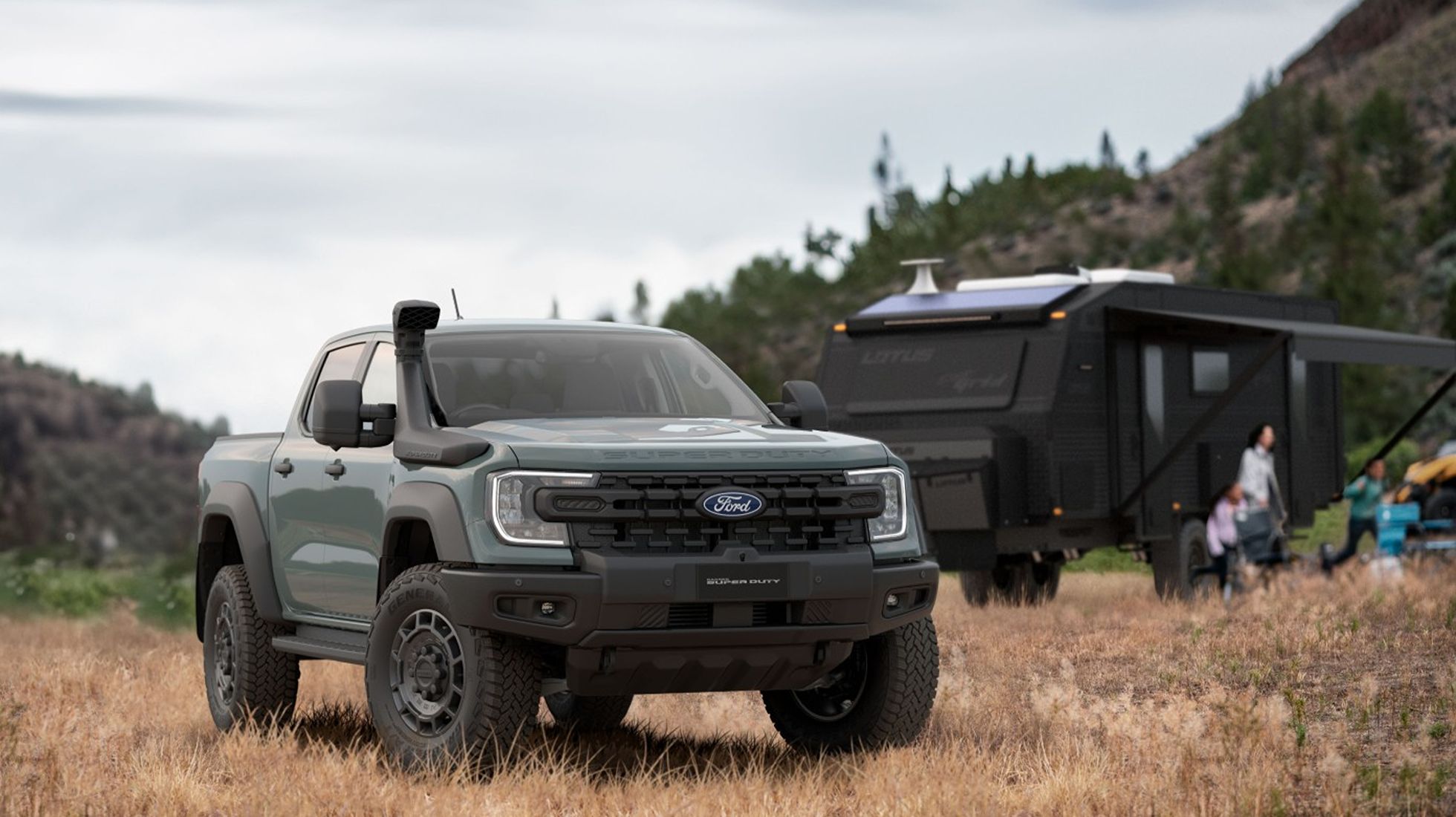
Sure, there’s never been any question about the Ford Ranger’s capability. But the new Ranger Super Duty exists for those who want to do more with their bakkie than the Ranger models were designed to handle.
Think of a farmer who has to cross rivers to reach livestock, a contractor hauling heavy machinery from site to site, or someone working in the mining sector where a bakkie is an essential tool. These are the people Ford had in mind when building the Super Duty.
The Super Duty joins the range in 2027 with four body styles: Single Chassis Cab, Super Chassis Cab, Double Cab Chassis Cab and Double Cab.
It’s a unique offer for the local market with a robust stance that many buyers in the segment would easily fall in love with. It comes with an impressive 4,500kg GVM rating, and because of that, it’s classified as a Code 10 (C1) vehicle. To give you a clear understanding of where it sits in the market, it occupies a territory where proper commercial vehicles rather than double-cab bakkies live. It also comes with a maximum towing weight of 4,500kg if you opt for the optional towball. If not, the standard towball accommodates a 3,500kg load.
An impressive feature, though, is the fact that you don’t have to manually calculate the weight of the payload. Sensors mounted in the suspension help owners estimate their payload as they add items to the bakkie. This can be monitored using the infotainment screen.
The Super Duty features the same chassis dimensions as the regular Ranger, but to make up for its strong carrying capacity, it runs a heavy-duty TT frame with increased strength and reinforced suspension mounts, box mount brackets and tow bar mounts, hence the GVM rating. It also features 8-stud wheel hubs with larger bolts to help spread the load.
Powering it is the tried-and-tested 3.0-litre V6 turbocharged diesel engine, which Ford says has been tuned for heavy-duty emissions standards and produces 154kW and 600Nm, but performance is secondary to capability here. It wields the familiar 10-speed automatic gearbox, but with improved cooling.
For an extended off-road range, Ford has swapped the 85-litre fuel tank for a bigger, 130-litre long-range tank with thick steel shielding designed to protect it from damage. The Super Duty also comes with high-strength steel bash plates as well as protection shields for the high-mounted engine, front differential, transfer case and transmission. As for wading depth, it’s been improved to 850mm while the ground clearance is almost 300mm.
As standard, the Super Duty range comes with front and rear locking differentials, with the former having been modified for enhanced load capacity.
While Ford SA is yet to confirm final pricing ahead of the Ranger Super Duty’s 2027 launch, it’s expected to start at around R1.1 million for the Single Chassis Cab and climb to roughly R1.3 million for the flagship Double Cab.
South Africa has always had a niche market for heavy-duty workhorses, and models like the Toyota Land Cruiser 79 have proven for years that buyers are willing to spend serious money on a bakkie built to work rather than play. The difference is that, until now, those buyers haven’t had many options to choose from.
Pricing could be the biggest talking point. If the suggested figures are accurate, the Super Duty will find itself in the same price bracket as the Ranger Raptor. That might seem like a difficult sell on paper at least, but the two couldn’t be aimed at more different buyers. The Raptor is all about high-speed off-road performance and lifestyle appeal, while the Super Duty has been engineered to withstand punishment.
Neither is better than the other, as they cater to vastly different needs, and there’s space in the market for both.