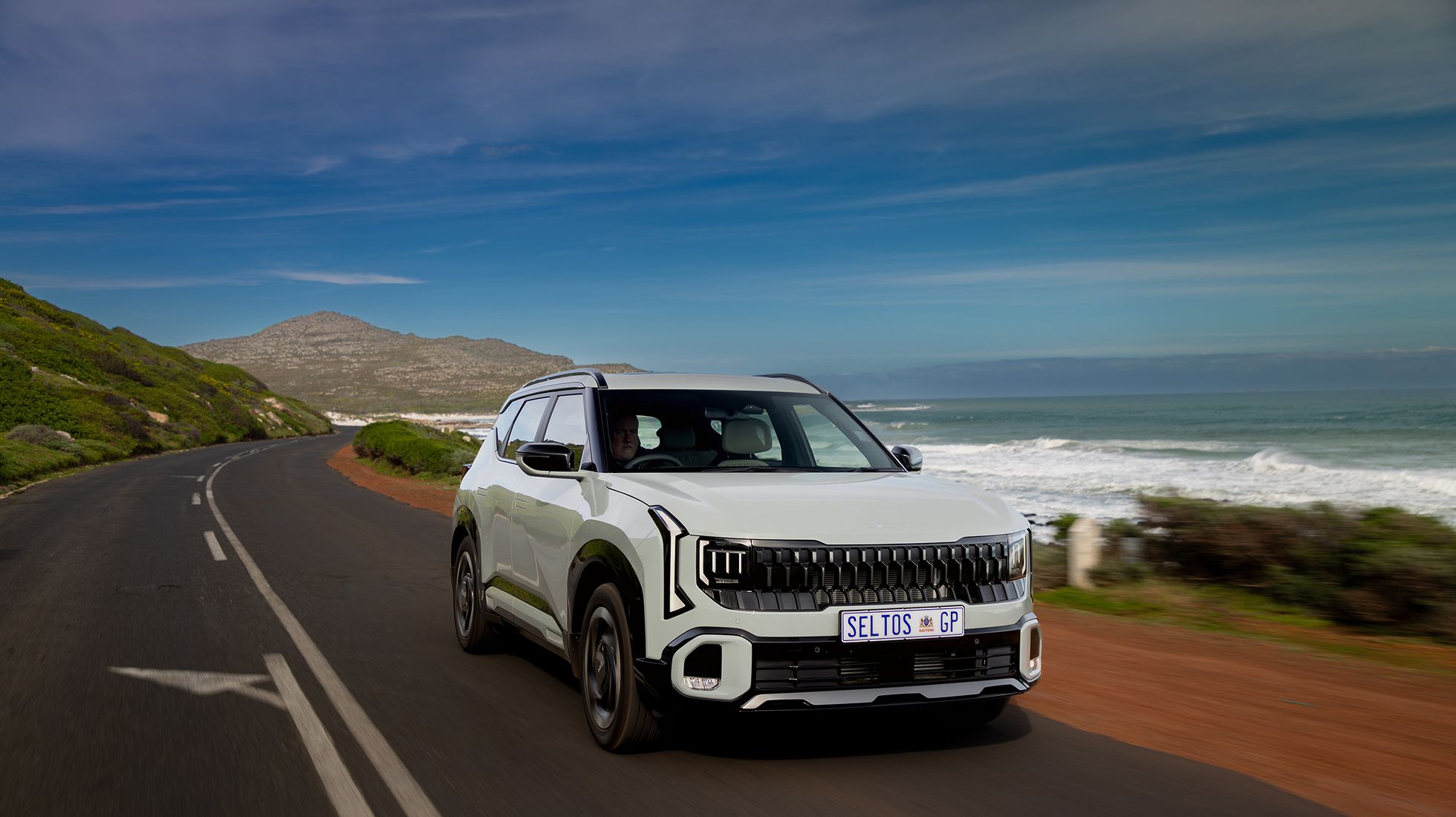


First Drive: Kia Seltos
I’m sitting on a flight to Cape Town when a strange sense of déjà vu creeps in. I’ve made this exact journey before. The year was 2019, just months before the world came to a standstill, and Kia had invited me to drive what would become the most important model in its local line-up.
Cape Town has long been the default setting for media launches. The weather rarely disappoints, the mountains never seem to deliver a bad photo, and the roads somehow make almost any new car feel better than it probably is. Seven years later, I’m heading back for another Kia launch. Thankfully, the memories this time have nothing to do with empty airport terminals, face masks or wondering whether the person in the next seat is running a temperature. Those days are behind us. Instead, I’m thinking about the original Seltos.
Back in 2019, compact crossovers were only beginning to lure buyers away from the hatchbacks and sedans that had dominated the local driveways for decades. The segment was growing, but it hadn’t yet become what it is today. Kia’s move was a strategic one. The Seltos quickly established itself as one of the brand’s most significant products, helping introduce buyers to the Korean manufacturer’s compact SUV range. Since then, the Seltos has remained a strong performer in the highly competitive C-SUV segment.
Is this really an all-new Kia Seltos?
Yes, it’s not a facelift. It’s an all-new model that has to carry the weight of expectations that its outgoing first-generation model had established. There’s no beating around the bush; rivals in this category have become capable, and perhaps the biggest question is whether lightning can strike twice.
The answer, based on my initial impressions, at least, is that Kia has refined the method of what made the Seltos a success in the first place. Aesthetically, it retains the familiar proportions while following the same maturity recipe worn by the brand’s latest products, with Kia SA mentioning at the launch that it’s the first model to be inspired by the large Telluride sold overseas.
I have no issues with how it looks. In fact, I think it’s one of the best-looking cars in the segment today. My only real gripe is with the flush-fitting door handles. If you’re going to have flush door handles, they might as well be automatic. In typical fashion, you’d expect them to pop out when the car is unlocked, but they don’t. Instead, you have to manually press and pull each handle out, which feels unnecessary.
More space, more tech and a more premium cabin
Inside, the changes are obvious, with a cabin that now feels more upmarket, more digital and considerably more spacious than its predecessor. The overall layout is clean and modern, and while the fit and finish is commendable, you’ll also notice where Kia has kept costs in check, with a few harder plastics reminding you that this is still a mainstream family SUV. In fact, it’s 65mm longer, 30mm wider, and the boot capacity has been extended by a sensible 103 litres.
Which Kia Seltos should you buy?
Before getting into the nitty-gritty of what each variant offers, it was the halo GT-Line S and X-Line that we drove at the launch, both priced at R614,995. And to address the next question, they’re effectively the same car, except that the X-Line adds an exclusive matte Dark Gun Metal Grey paint finish, black alloy wheels and a two-tone Hunter Green and Dark Grey interior. So, you get more for the same price. That’s probably the easiest way to explain it.
Below these two models live the entry-level LS, LX and GT-Line variants. The LS comes equipped with a 10.25-inch infotainment touchscreen, 17-inch alloy wheels, LED lighting, wireless Apple CarPlay and Android Auto, six airbags and rear Park Distance Control. The LX adds a larger 12.3-inch infotainment display, front Park Distance Control, dual-zone climate control and Smart Key with push-button start.
The GT-Line builds on this with unique exterior and interior styling, 18-inch alloy wheels, a panoramic sunroof, 64-colour ambient lighting, a wireless smartphone charging pad, an electrochromic rear-view mirror and rain-sensing wipers. Above it, the GT-Line S and X-Line pair the 12.3-inch infotainment display with a fully digital 12-inch TFT instrument cluster, while also adding a Bose premium sound system, ventilated front seats, a power-adjustable driver’s seat, Smart Cruise Control and Kia’s full suite of advanced driver assistance systems.
Kia Seltos engines: petrol, turbo petrol or diesel?
When it comes to engines, the LS, LX and GT-Line models are powered by a 1.5-litre naturally aspirated 4-cylinder engine producing 85kW and 144Nm. The entry-level LS gets a 6-speed manual gearbox, while the LX and GT-Line are paired with a CVT.
It’s a good thing Kia still believes in diesel, with both the GT-Line and X-Line models utilising a 1.5-litre 4-cylinder turbodiesel producing 85kW and 250Nm, paired exclusively with a 6-speed automatic gearbox.
The diesel makes a strong case for itself
It delivers impressive shove when you need it, making overtaking and climbing those long mountain roads feel almost effortless. The launch route included a decent mix of steep climbs and descents through the mountain back roads, which gave me enough time to appreciate just how relaxed the diesel feels. It’s comfortable, smooth and, more importantly for the local market, feels like the engine many buyers will naturally gravitate towards.
After lunch, I settled into the 1.5-litre 4-cylinder turbopetrol that powers the GT-Line S models. It produces 119kW and 253Nm, with the power sent through a dual-clutch transmission. Kia positions this as the more spirited option, although I suspect most buyers will be choosing it for reasons beyond outright performance. There’s enough punch from the moment you put your foot down, but you immediately miss the effortless torque delivery of the diesel. You also lose some of that relaxed feeling when tackling hills or settling into an overtaking manoeuvre.
That said, the petrol Seltos is by no means uncomfortable. If anything, it’s a refined and easy-going SUV that does exactly what a family crossover should. The steering is light, the ride is composed, and the cabin remains quiet enough to make long-distance trips feel effortless. It doesn’t beg to be driven hard and is at its happiest cruising along, which is probably how most Seltos owners will spend their time anyway.
Is the new Kia Seltos worth buying?
And somewhere between those mountain back roads, the déjà vu returned. It still feels like Kia has understood what buyers want from the segment, and if you ask me, that’s comfort, practicality, and versatility. Period.
On the flight home, I find myself thinking about that original trip I took some years ago. It’s different now, with Kia taking the same idea and improving on it for a market that has become considerably more demanding.
Will it repeat the success of the original? That’s impossible to know from a first drive. But after seven years, the Seltos hasn’t lost the bits and pieces of what made it successful and an important model in the first place. The market has grown, competition has intensified, and Chinese brands are coming for almost every corner of it. So, the Seltos has a lot to prove, but from my first impressions, it has what it takes to make buyers in the segment stop and take notice. The pricing is attractive too.
Would I buy one? A resounding yes, I’d just make sure it’s the diesel.
Kia Seltos Pricing
- Seltos 1.5 LS MAN: R389,995
- Seltos 1.5 LS CVT: R414,995
- Seltos 1.5 LX CVT: R464,995
- Seltos 1.5 GT-Line CVT: R514,995
- Seltos 1.5 CRDi GT-Line AT: R544,995
- Seltos 1.5 T-GDi GT-Line S DCT: R614,995
- Seltos 1.5 CRDi X-Line: R614,995