Home  Topgear Garage Hyundai Creta 1.5D Elite: Frugal, Spacious, Versatile

R568,900
It’s a hearty welcome to the Hyundai Grand Creta 1.5D Elite to our long-term fleet garage. Yes, the compact 7-seater will be in our care for the next 6 months as we put it through its respective paces.
While functionality supersedes styling in this instance, the Grand Creta has not been beaten with an ugly stick, as one of my team members has purported. Youth! They hurl insults if it isn’t a fancy, modern sports car. Actually, I digress, so back to the Grand Creta then, and I feel that Hyundai has placed the right product in the market. What do I mean? Well, let me elucidate.
Most 7-seaters are either MPV, bakkie-based or outright luxury monocoque items, meaning those shopping for a small SUV have very little in the way of options. This is where the Grand Creta succinctly plugs that gap by offering a decent-sized 7-seater SUV. It has very little in the form of excess, but it’s still comprehensively specified to appease a family’s requirements. Let us begin with those trivial, yet seemingly useful USB ports. There are front-row, middle, rear and even boot-mounted USB ports, which means mobile devices such as smartphones and tablets can be charged, a boon for those long-haul family sojourns. Tick!
Private rear windows and a panoramic sunroof are additional standard features. Apple CarPlay and Android Auto, not to mention a wireless charging tray, are also part of the standard list of items. Front seats are ventilated, but not heated, while the driver’s seat is also electrically adjustable. Tick! Thanks to the extra 15 cm legroom compared to the standard Creta, the Grand, as I will abbreviate it going forth, has surprisingly good legroom even for the rearmost passengers. Tick! In fact, we recently managed to cram the Grand chock-full with a total complement of seven passengers all the way to the province of Mpumalanga, the results of which we will share in our next report.
Motivation in our Grand comes in the form of a 1.5-litre turbo diesel engine putting out humble outputs of 84 kW, and 250 Nm shuffled through a 6-speed automatic transmission to propel the front wheels. What it lacks in power, it more than makes up for in exceptional fuel economy. While we are still running in the engine, a figure of 6.4l/100 km is more than acceptable, giving us around 840 km (urban driving) range from the 50-litre tank. Tick! We will, of course, be aiming to eke out a range of 1,000 km from the tank on an extended trip. We will report on this soon.
Unassuming in the way it goes about things, the suspension damping, in particular, is excellent and tackles road imperfections with aplomb. Those 18†alloy wheels have reasonably thick sidewall tyres, making unpaved road travel relatively comfortable. Tick!
Those LED headlights offer exceptional lighting on the road ahead at night. At the same time, the digital instrument cluster not only beams vital information to the driver but also elevates the Grand’s cabin ambience. Overall, a well-appointed interior.
On paper, the price sticker of this diesel Elite does seem a bit much. Still, considering the specification that comes as standard, not to mention the thrifty fuel consumption, especially with current fuel prices, it makes a compelling case for itself.
We are still getting acquainted with the Grand’s positives and quirks. Still, first impressions are that it is a capable, compact family crossover with space for seven occupants. Look out for exploits in the next update, where we put the vehicle through rigorous testing.
I have a friend. Big whoop, right? This mate, if we’re to remain mannerly, is a die-hard motoring trivia geek. Most likely, he’ll be able to tell you the exact suspension travel on your SUV. The codename of your engine? Easy. Even who it was that thought it’d be a good idea to position a conrod in a specific way before going on a tangent on the greatest moments of Bathurst’s Conrod Straight.
I thank him for my general aversion to the Creta nameplate. Not as a commentary on the crossover’s abilities, but what “Creta” means in some obscure, I’ve-never-heard-of-the-slang, tongue that you’ll likely find on page 20 of a Google search. I’ll give you a hint; it’s not polite. Someone at Hyundai must have not been paying attention or had a wicked sense of humor, arguing in a PowerPoint presser that it means “powerful” in Greek.
My point is that, like its name, the first-gen Creta that launched in South Africa felt half-baked; like a stopgap measure to lure signatures on dotted lines away from the likes of Nissan, Toyota and Ford. The Creta nameplate had no interwoven golden thread with the brilliantly capable Tucson and Santa Fe models of the time, no desert-and-tumble-inspired name, and none of that feel-good charisma of its siblings. While not bad on a technical level, it felt like a watered-down budget interpretation of the brand’s greats. Something you needed due to budget constraints, not necessarily wanted. But that’s changed, for the most part.
Its name is still Creta, and it is adorned with the Grand prefix to signify its seven-seat capability. I still chuckle when saying it out loud, but, and this is a commentary on the SUV’s ability, it’s a serious contender in the seven-seat, small SUV segment.
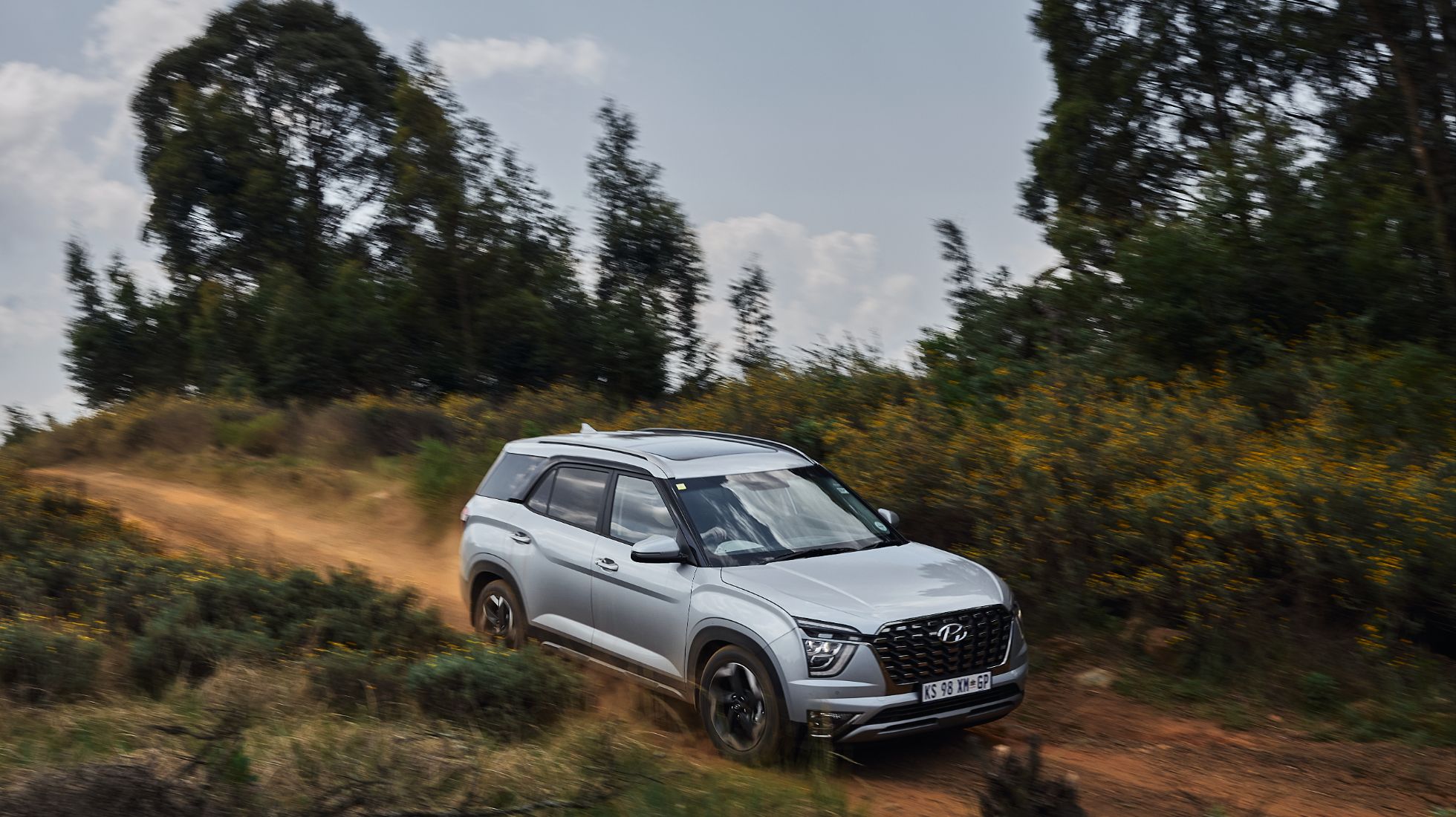
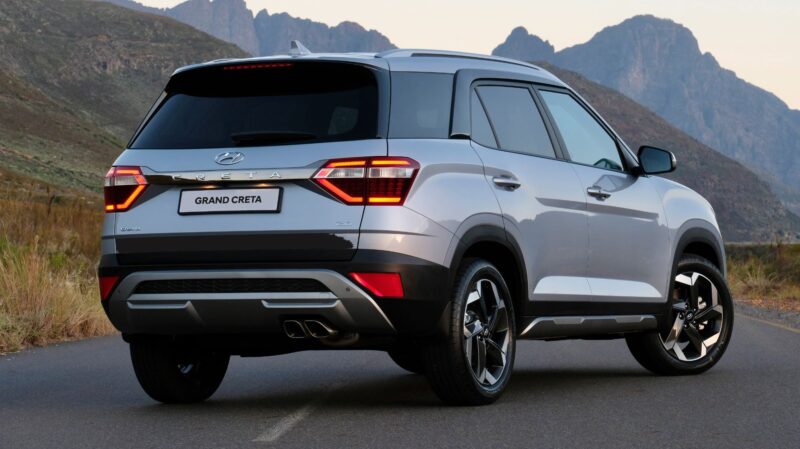
It wears a muscular front-end garnished with a dark-accented geometric grille, attractive 18″ wheels and a considerably elongated side profile thanks to a 15 cm increase in wheelbase compared to that of the smaller, outgoing Creta.
In terms of the Grand Creta’s interior space, this allowed for the addition of two additional seats. While gargantuan in terms of usable space, the third-row seating still only accommodates the young ones. No surprise really, since the Grand Creta is geared towards growing families and for that, it seems a hard proposition to beat. I employed the services of my two dedicated family vehicle apprentice testers to sample the third row in a bout around town and they gave it the nod of approval in terms of ingress and egress. The only real problem came in the form of the off-cream-coloured seats that I’m not convinced will remain crisp after a few Happy Meal bribery runs through the drive-through. That should have been better thought out, if I’m honest.
In terms of standard specification, the Grand Creta 1.5 Elite Diesel is well equipped with all the creature comforts you can reasonably hope for. An 8″ infotainment screen with both Apple CarPlay and Android Auto is standard across the range. So too are wireless charging capability and cruise control. The Elite derivative further brings with it a 10.2″ digital tachometer and speedometer, a sunroof, auto climate control and seat ventilation.
As mentioned earlier, this is the diesel Elite and it represents the top tier of Grand Cretaness. It’s powered by the proven 1.5-litre turbo-adorned oil-burner in Hyundai’s stable, and while it won’t win any prizes on the power front with its 84 kW and 250 Nm deliverables, it was easily one of the most frugal vehicles I’ve tested to date. With mindful driving in and around town, it averaged at its best only 5.3l/100 km. That’s 1.2 litres less diesel used per each 100-kilometre stint than Hyundai’s claim of 6.5. It’s not the most refined of powertrains, though. Coupled to a 6-speed auto ‘box, the Grand Creta did have the occasional gearbox jolt in slow-moving traffic as it was caught out by an onset of torque upon acceleration. Also, not a lot was done to insulate the passenger cabin from the agricultural-like clatter of the diesel engine, especially at a cold start. Small, inconsequential details that hardly detract from an otherwise excellent engine, one that could potentially save you several trips to the filling station in the long run.
Aside from the missed opportunities of coherently cementing this car into Hyundai’s SUV lineup with a name like ‘Hyundai Reno’ (just a suggestion), the Grand Creta has rightfully taken its place at the top of the small seven-seater SUV segment against the likes of the luxurious but fuel-guzzling and unproved Chery Tiggo 8 Pro and the long-in-the-tooth Nissan X-Trail.
Funny name aside, though, I know where I’d spend my money.
I guess I’ll now hear why Reno won’t work. Sigh…
Since our first introductory report on the Hyundai Grand Creta, a lot has happened. Its biggest call to date was to transport crew and gear to and from the 2022 edition of Speed Week, which you have, no doubt, just spent time reading.
That’s no small job, as the Speed Week feature has attested. The thing about our choice of accommodation in Mpumalanga was that none of the performance cars could drive there, such was the state of the rough gravel roads to the lodge. The Grand Creta was one of only three vehicles charged with moving seven adults to the lodge daily, gear and all. It was certainly put through its paces with changing weather conditions that made for changing environments. Some days were gloomy and wet, which meant tired and soiled shoes in and out of the ‘Grand’. On some days, the sun was menacingly harsh, resulting in dry and dusty conditions. You get the picture.
This kind of work brings the Grand Creta’s build quality into order and the aftermath of Speed Week revealed some key insights. It’s a solid cabin, no doubt, a fitting reminder of how far this brand has come in just a few decades. The need for hard-wearing plastics makes sense, on the one hand, ably dealing with the crew day in and out, yet they’re also a standout factor in being an anomaly to the rest of the cabin’s plusher materials.
Despite the daily trundle at Speed Week, the Grand continues to impress as a people mover. The long road to and from Johannesburg and a jaunt to Piet Retief in Mpumalanga proved just how efficient and comfortable the Grand Creta can be. Our current consumption of 6.1l/100 km is part of that, but the figures for the long trips are 5.4 and 5.5l/100 km, respectively. We managed to eke out 899 kilos on a tank before filling up. There’s certainly more that can be achieved, but the route plan didn’t allow it.
That 1.5-litre turbodiesel performs admirably. Whilst it is only an 84 kW output, it’s reasonably easy to judge the oomph when planning overtaking manoeuvres. Ride quality is also good, thanks to a large chunk of rubber on the tyre profiles. The car deals with the multitude of uneven and pothole-infested roads with a lot of forgiveness. Whilst its ride quality is good, it suffers some body roll in corners and can become light on its feet when riding through deep undulations. These are everyday things for what the Grand Creta is, though. It’s a competent vehicle in its segment.
And then, of course, any 7-seater must be easy to operate. Ingress and egress here are easy with one handle to move the seats forward, and easy-to-use pull handles if you’re opening or closing the 3rd-row seats from the rear. It’s a usable cabin, and as we’ve expressed before, the USB ports and tray tables make for a family/people-oriented cabin. As we get into the heart of summer, the climate control has also been called into some real action, a premium addition to the Elite-spec Grand Creta.
We get the impression that the Grand Creta’s overall performance will improve as our test period continues. Our previous report also noted a slight price increase from R568 900 to R580 900. This is a typical trend within the industry, attributed to the exchange rate and current economy, but it does mean that if you are considering a pre-owned Grand, ensure you keep that in mind.
We’re five months into our long-term stint in the Grand Creta, and it is nearing that time when we can take it for its first service at 15,000 km. The thing is, we’ve already been to see a dealer for a niggling oil issue that was as surprising to the service manager as it was to us.
At around 9,650 km, just before I set off on a lengthy 1,400 km journey, I pulled into my local service station to brim the 55-litre diesel tank and do a thorough pre-trip inspection. Tyres and internal operating fluids were checked, and to my surprise, the Grand Creta was very low on oil, measured at around 40% of the dipstick markings. It required two pints to fill it. I was concerned. My first question was whether my assumption of a 15,000 km service was incorrect and that the car was due for its 10,000 km oil service. I duly scrolled through the onboard driver’s display menu to find that the service was indeed overdue… or so I thought.
Upon my return to Jozi, I diligently booked the car in at Hyundai Fourways after a bit of back and forth with the service advisor, who was adamant that the vehicle was only due in at 15,000 km. I argued that the oil was low and that the onboard computer disagreed with him. The car was taken in but not serviced, and instead booked in to diagnose this oil issue. It was ‘checked’ and ‘sealed’, and I was advised to return the car for a check-up in 2,000 kilometres. I was then handed a R240 bill. Didn’t the 4-year/60,000 km service plan cover this cost? Apparently not.
At the time of sending this story off, the Grand Creta had been booked in for its check-up the following week. We’ll bring you more on this story as it unfolds, but it is something to bear in mind. What is certain is that the GC is sold as having 15,000 km service intervals and not 10,000 km. The onboard computer has been changed since, which is odd.
Despite these after-sales wobbles, the Grand Creta continues to prove its worth as a conservative SUV with impeccable fuel economy. That really is the big news here now, ably turning in under 5.0l/100 km on long journeys. I’ve achieved 4.5l and 4.6/100km on two occasions over the last month… it just keeps improving.
Another notable quality to mention is its hard-wearing cabin and easy-to-operate seven-seat configurability. Both adult and child rear seat occupants love the rear seat climate controls, device charging ports, and tray tables affixed to the back of the two front seats with space for food, laptops and drinks.
With all the rain these last few weeks, the potholed roads have been a menace to cars with stiff suspensions and lower profile tyres. The Grand Creta has given us peace of mind with its soft and comfortable road manners, not to mention the 200 mm ground clearance and 215/55 R18 rubber.
2023 pricing is slightly increased by R2,000, making the Grand Creta still a decent value proposition for what it is.
Our Hyundai Grand Creta continues to impress in most instances, but a few things require some attention. For starters, the vehicle started burning oil, as we previously reported, but this was resolved by Hyundai Fourways at a R240 bill.
This included a top-up of a litre of oil and the sealing of the dipstick. However, we were also experiencing some tyre pressure monitoring issues, with the onboard computer indicating low tyre pressures all around. Of course, as one would do, we headed to our nearest petrol station and dispensed some air into the tyres as per the manufacturer’s recommended pressures, sadly to no avail.
We duly booked the vehicle in for a service at Hyundai The Glen for its 15,000 km check-up, a process that was quick and easy. The following morning, a Friday at that, we dropped off the vehicle, it was booked in and inspected for any cosmetic damages, which took all of 15min, and we were shuttled back home. Throughout the day, we received about two courtesy calls from the service advisor, Shuaym Ali, informing us of the progress of the service.
The following work was carried out; Filter Cartridge (R744.85), Oil Filter (R250.61), Air Filter (R512.42), Gasket Oil Plug (R10.96), Windscreen Cleaner (R19.53), Synthetic Oil (R504.00), while Labour came up to R1,144.80. The Grand Total worked out to R3,767.60, covered under the 4-year/60,000 km service plan.
According to Ali, the tyre pressures were reset and corrected. He explained that some of the petrol stations’ tyre pumps are not correctly calibrated and are bound to give false tyre pressure readings, which happened in our instance. I finally received a call around 16h00 on the day to collect the vehicle, but since I was a little further away from the dealership, I asked if I could instead collect the vehicle the following day, to which they affirmed that it was fine.
Upon collection on Saturday morning, the car was cleaned and parked in the pre-owned vehicle sales undercover parking, and all the old parts removed during service were placed in a box and on the passenger footwell. All the tyre pressure error messages were reset, and our Creta was purring like new. We are currently averaging between 4.7 and 5.2l/100 km, which is incredible and most welcome during these volatile high fuel prices.
There is definitely value to be had in a small-capacity diesel SUV, and the Grand Creta continues to make a robust case for itself, and we are equally impressed by what it has to offer small family SUV buyers.
In last month’s report, we mentioned that our long-term Hyundai Grand Creta was due for its service, and it has been purring along since with no issues.
It continues to make a strong case for itself as an SUV that can handle traffic jams efficiently, support the team on shoots and launches, and serve as a perfect family SUV. A spacious and comfortable vehicle with smart technology is required to achieve these tasks, and the Grand Creta delivers just that.
Though it may be overshadowed by other stalwarts in the 7-seater SUV fold, we regard it as one of the best options currently on the market for families that require the extra third row of seats while offering owners the financial relief of spending less on fuel.
After completing the service, we took the GC on a long journey to Tzaneen. On the open road, we noticed that the 1.5-litre 4-cylinder turbodiesel engine, combined with a smooth-shifting 6-speed automatic transmission, was more powerful and responsive. Although the rest of the vehicle was enjoyable, the overuse of hard plastics inside is somewhat disappointing. Then again, it is a family vehicle…
On the flip side, the GC is designed for comfort, providing ample support for long journeys with cooled front seats. The infotainment system is also user-friendly, and there are USB ports in the front, middle, rear, and boot areas for convenience during long trips.
Regarding thriftiness, there has been a notable improvement in its fuel economy. On the open road, the numbers continue to hover around 5.5l/100 km, and if you drive with efficiency in mind, they plummet below the 4.4l/100 km mark, with the full-tank driving range coming close to 800 km.
While initially sceptical about the vehicle’s design, we’ve come to appreciate its aesthetic features. The Grand Creta is a well-styled vehicle, with striking LED headlights, a bold front grille with dark chrome accents, and stylish 18″ alloy wheels.
While it continues to occupy our long-term garage, the Grand Creta is a notable contender in the subcompact SUV stable, and its diesel powerplant makes it even better. Yes, there are niggles, but these are hardly enough to deter buyers who prioritise value for money and running costs.

Get TopGear SA news and reviews in your inbox